Search This Blog

Pages

Tuesday, 1 March 2016

Searching for Stolypin: Democratization and the War against Corruption


Alexei Navalny at the 'Russian March', September 2011


At a time when the conflict over Crimea and skirmishing in Donetsk and Luhansk are driving an ever greater wedge between Ukrainians and Russians, the one political issue that seems to unite both societies is anger with endemic corruption. For the past decade, more or less robust social surveys have put corruption at or near the top of the list of issues that most concern the public in both countries. State dysfunction and social injustice that corrupt practices helped to entrench have undermined economic development in most societies struggling with Soviet legacies. The ways in which graft and bribery have become a feature of everyday life affecting every citizen have fostered deep public grievances against established elites that have a potentially destabilizing impact. 

In Russia, significant levels of public disquiet over the persistence of corruption lingered even as a political equilibrium put in place by Vladimir Putin's power vertical managed to limit the socially disruptive effects of graft between 2000 and 2010. As Vladimir Gel'man has pointed out, with memories of the social collapse of the 1990s still strong during the first Putin presidency the great bulk of the Russian population was willing to accept a degree of elite theft in exchange for a stable order in their everyday lives. The rapid increase in quality of life driven by a growing commodities boom helped to limit the extent to which public annoyance at tales of corruption seeping out from the Kremlin fostered discontent with an emerging authoritarian order. Yet the fact that the police and security services regularly made a show of arresting expendable members of the elite demonstrated the extent to which those ruling Russia were aware that public concern over corruption needed to be regularly assuaged in order to sustain Vladimir Putin's popularity. 

By contrast, until 2010 in Ukraine no one figure was able to entirely dominate the state. The competitive nature of a political system that sat somewhere between oligarchy and democracy survived during the first two decades of Ukraine’s independence despite Leonid Kuchma's moves to consolidate his position in the early 2000s and Viktor Yanukovych's attempt to manipulate the 2004 presidential elections. In both cases a mixture of popular and elite resistance stymied attempts to entrench a power vertical in Kyiv, helping to foster a relatively open society in which nascent activist networks and small enclaves of reformers within civilian and military institutions could lay the basis for reform of the state. Yet a parliament and presidency riven with factional rivalries also made it extremely difficult for reformers to make any headway in a political economy in which oligarchs were constantly fighting for survival. While Putin's power vertical set clear limits on the influence of economic elites, the lack of any equivalent power centre in Ukraine meant that graft, corruption and everyday bribery spiralled out of control in a manner that paved the way for the comeback of Viktor Yanukovych in 2010.

Despite these growing divergences between Ukraine and Russia, the financial crisis that began to unfold in 2008 created a range of social and political shocks that brought ever greater discontent out into the open. With a massive spike in gas and oil prices strengthening the hands of oligarchs more closely aligned with Russia, between 2010 and 2013 Viktor Yanukovich moved to consolidate power to an unprecedented extent. In Russia, the swift recovery in commodity prices enabled Vladimir Putin to invest massive sums in the military while still maintaining the ability to financially outbid any potential rival. Yet in both societies economic pressure after 2010 also heightened public frustration with the persistent impunity of those in control of the state and economy. Uniting the disparate groups involved in the mass protests in Moscow of 2011 and 2012 was anger at how the return of Vladimir Putin to the presidency signalled a lack of will to reform a system built on brazen plundering of the Russian economy. While the Russian protest movement failed to attract sufficient support outside of Moscow to threaten the Kremlin, in the following years similar fury at systemic corruption helped fuel the Maidan protests in Kyiv that culminated in the toppling of Viktor Yanukovych in February 2014. 

Since the Putin regime’s manipulation of corrupt networks to achieve strategic goals in Donbas and Crimea a considerable proportion of the political elite in Kyiv now see the war against corruption as crucial to restoring national sovereignty and security. In Russia, the extent to which the Kremlin’s power vertical depends on corrupt deals between the security services and economic elites have led the opposition to primarily focus on anti-corruption activism, often at the expense of other key issues. Moreover, the extent to which key members of the Russian opposition such as Alexei Navalny have built their reputations on anti-corruption campaigning demonstrate how the war against corruption has remained one of the few issues that can still unite a fragmented opposition movement. 

As a consequence, many analysts and activists have come to see a war against corruption as an unproblematic component of any wider democratization process. When providing recommendations for the democratic transformation of both Ukraine and Russia, Western think tanks, scholars and prominent local figures continue to often place the suppression of corrupt practices as the central priority of any reform process. EU and US officials, scholars and analysts at think tanks from the Carnegie Foundation to the Brookings Institution regularly churn out recommendations for anti-corruption measures designed to restore the rule of law in the post-Soviet space. As the military situation in the Donbas region has stabilised, in Ukraine battles over corruption within the national government as well as on a regional level have shaped political debate, often determining the rise and fall of prominent leaders. While in Russia, the remnants of the non-system movement are trying to mobilise public support by emphasising the extent to which the corrupt practices so central to Putin's power vertical are compounding an escalating economic crisis.   

Yet however crucial anti-corruption measures are to the restoration of the rule of law, it is worth asking whether wars on corruption in themselves inevitably lead to democratization. Western as well as local analysts often assume that those prominent political figures fighting for an end to corrupt practices, often at enormous risk to themselves and their families, are also automatically going to push for the democratization. But demands for a "cleansing of society" or a "strong hand" to fight powerful interests that are stealing from the people and subverting the state can also degenerate into a search for the kind of quick solutions that are more likely to be found through authoritarian methods than slower processes of democratic consultation. 

The authoritarian potential of any potential war on corruption can be seen in the historical figures anti-corruption campaigners in both societies have cited as examples. After the collapse of the USSR encouraged a reappraisal of the pre-1917 Tsarist Empire, both conservatives as well as liberals in Russia have often pointed to Pyotr Stolypin as a figure who could provide a model for those trying to rebuild Russia in the 1990s. Until his assassination in 1911, as prime minister and interior minister Stolypin initiated reforms designed to save the Tsarist system in the wake of the revolutionary events of 1904. The apparently progressive nature of measures designed to foster the emergence of a rural middle class and a more responsive state led many Russian reformers to present Stolypin as the kind of figure those rebuilding a new Russia in the 1990s and 2000s should emulate. Yet Stolypin was also notorious for the ruthlessly repressive means he used to impose his own institutional goals. His relentless war on corruption went hand in hand with a campaign against various ideological opponents of the Tsarist system so brutal that the "Stolypin necktie" became a euphemism for the noose used to execute those accused of revolutionary terrorism. A war against corruption building on a cult of Stolypin may help unite those in the security services frustrated with a corrupt status quo with activists close to the opposition. Yet it also hints at a willingness among many anti-corruption activists to entertain an alliance with individuals or groups who could provide the "strong hand" needed to "clean up" their country.

Though some Ukrainian activists also cited Stolypin as a useful model for modern anti-corruption efforts in the 1990s, growing wariness towards Russia dampened enthusiasm for a politician whose main aim was to restore the strength of a Tsarist Empire focused on Moscow. Nevertheless, an authoritarian undercurrent can also be detected in some of the precedents many anti-corruption campaigners have pointed to as successful examples of reform that should be emulated. That some activists have pointed to Singapore's Lee Kuan Yew as an ideal for reformers despite his unflinching contempt for human rights indicates that quite a few anti-corruption warriors in Ukraine may be willing to cut a few democratic corners to achieve their goals. More recently, the popularity of Mikhail Saakashvili after his appointment as Governor Odessa by President Petro Poroshenko is a sign that a broad swathe of the electorate is willing to throw its support behind someone willing to do whatever it takes to fight corruption. That Saakashvili was toppled from the Georgian presidency in 2013 under a cloud of allegations over abuse of executive powers to coerce acceptance of reforms does not seem to unduly bother Ukrainian anti-corruption activists and voters rallying to his standard. 
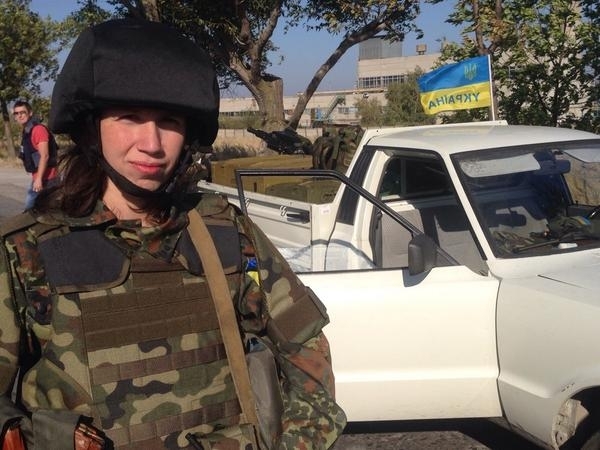


Tetyana Chornovol at the Battle of Mariupol, September 2014.

Other prominent activists involved in anti-corruption campaigning in Ukraine have become heavily involved with openly authoritarian movements. The paramilitarisation of the Maidan movement under the pressure of brutal police repression in January 2014 drew civil society activists into contact with radical nationalist as well as self-defence units that protected demonstrators from the state. These groups went on to provide the nucleus for the volunteer regiments that spearheaded the attempt by the Ukrainian military to regain control of the Donbas region from increasingly blatant Russian military infiltration. In the process, anti-corruption campaigners helping to coordinate public efforts to supply the military have drawn close to paramilitary groups and other military units. 

A prominent example of this interaction between anti-corruption activists and nationalist volunteer regiments is the former journalist Tetyana Chornovol, who is now an MP in the Verkhovna Rada. Chornovol herself rose to prominence during the Maidan protests for her relentless investigation of the Yanukovych family's illegal assets. In the months after Yanukovych's fall, her husband joined the far right Azov regiment, and was killed in action near Ilovaisk. Following this personal tragedy, Chornovol  joined an Azov unit fighting to defend Mariupol from seizure by Russian and Russian-backed forces in August 2014. This strong personal link along with her continued association with figures connected to the Azov movement indicates how a commitment to fighting corruption can be built as much on an authoritarian understanding of how social transformation should be achieved as it can on a desire to preserve democratic pluralism.

As long as the European Union provides the prospect of even a partial integration process, there remain strong institutional incentives for Ukrainian activists and state reformers to frame their war against corruption in democratic terms. Having a battle over the reform of the Ukrainian state play out in an open debate in the media and parliament will also strengthen public understanding and elite acknowledgement that corruption is a symptom rather than a cause of a political crisis driven by deeply entrenched social injustice. As Mikhail Minakov and Vitaly Portnikov have pointed out, the potential risks of EU disengagement from a society in which there are no simple solutions to structural dysfunction are clear. In an environment in which old civilian elites are discrediting themselves and the power and prestige of the military is on the rise, there is a strong risk that the fury of Maidan activists at the survival of corrupt practices could reinforce authoritarian rather than democratic trends in Ukrainian society. 

While in Ukraine a public consensus in favour of an (often ill-defined) Europeanisation process provides an incentive to channel the war against corruption towards democratic ends, it is not clear whether similar external or internal pressures exist in Russia to prevent activists from being tantalised by the false promise of authoritarian solutions. Undoubtedly there are many key figures within the system and non-system Russian opposition who make great sacrifices in the hope of building a more open society. But the assassination of Boris Nemtsov removed a leading figure that still had the authority to sustain a commitment towards democratic goals among those frustrated with the status quo . With Nemtsov gone it remains unclear whether what remains of the Russian non-system opposition can produce a leader that can ensure that anti-corruption work remains part of a wider democratic project rather than becoming enmeshed with the authoritarian agendas of nationalist movements or factions within the state. 

Perhaps that most prominent Russian opposition activist to have flirted with the authoritarian agenda of the nationalist Right is Alexei Navalny. As a prominent opposition activist, Navalny has been very successful at using anti-corruption activism as a springboard towards building a national political profile. Most recently, Navalny played a central role in implicating Prosecutor General Yury Chaika in vast protection rackets that effectively turn the state prosecution service into a business partner of major organized crime groups. Throughout Navalny has had to overcome enormous pressure from the Russian state. Yet Navalny has also courted the support of Russian radical nationalists, even attending the so-called 'Russian March' in 2011, a notorious annual gathering of the Far Right in Moscow. In the process he has become difficult to pin down ideologically, at times espousing a national conservatism that would not seem out of place in the Lithuanian or Polish parliaments, at others indulging in the kind of opportunistic populism that would make Ukraine's Oleh Lyashko proud. This ideological ambiguity coupled with cooperation with deeply authoritarian radical nationalists is an indication of how prominent anti-corruption campaigners such as Navalny will not necessarily prove reliable supporters of any messy democratic Russian experiment that may follow a collapse of Putin's power vertical.

For democracy is not necessarily an inevitable outcome of any revolutionary moment that may unfold if the Putin regime is unable to reverse Russia's downward economic trajectory. The deeply corrupt relationships between the security services and business elites that provide the structural foundation for Putin's power vertical make both highly exposed to any public backlash that could emerge if Russia experiences internal destabilization. But there are other state institutions that have not been as weakened by the predatorial instincts of the Putin regime. In the last decade the military in particular has become ever more central to national life, profiting from rapidly expanding budgets while enjoying ever greater social prestige as celebration of the army becomes entrenched in cultural institutions and school curricula. With the personalized nature of Vladimir Putin's rule hollowing out a whole range of other state and political institutions, after his fall the military may be the only truly national institution able to act as a unifying force. 

In this context, over the next decade those Russian activists fighting the war against corruption may be faced with a difficult set of choices. They could embrace a democratic transition that will involve complex political deals with many powerful figures who had prospered under the previous regime. Such a scenario would also put clear limits on the extent to which any crackdown against corrupt elites can ignore property law and human rights. Or they could work together with military leaders and radical nationalists willing to use all means available to crush business and security service networks that have stolen Russia's future for the last twenty years. The tendency of many Russian activists to see corruption as the primary cause of Russia's ills, rather than as a symptom of deeper social and economic injustice, is a worrying sign that a significant proportion of Russia's opposition may very well be tempted by men in uniform who promise to do whatever it takes.

While the EU still has a wide range of incentives to ensure that anti-corruption warriors in Ukraine respect democratic norms, it is difficult to see how European states can influence the fateful choices activists fighting the war against corruption in Russia may have to make in coming years. A concerted effort to embed anti-corruption measures into a wider democratization process could help weaken the ability of established elites to manipulate economic reforms to their advantage. Such a success could mark a crucial step towards building the foundations for a more stable and just society. Yet in the chaos of the next Russian revolution it is entirely possible that rather than finding its Havel or Walesa, Russia's opposition may simply choose to fall in behind a Stolypin instead.


Friday, 27 November 2015

Coming to Terms with Odessa Ukraine: How Maidan Reshaped the Ukrainian Diaspora


Canadian Cossacks at Dauphin's Canadian National Ukrainian Festival, 2011.


For over a century Ukrainians facing economic deprivation and political instability have left their homeland to find work in distant countries. As successive waves of mass migration gained momentum Ukrainian communities emerged in Europe, North America and even farther afield. From its very beginning, Ukrainian emigration to Europe and North America in the nineteenth century took place in parallel with the first attempts by Ukrainian intellectuals to construct a shared sense of nationhood. A Ukrainian nation-building project that hoped to unite divided territories through a shared linguistic and cultural heritage became intertwined with processes of transnational migration and community-building. This expanding Ukrainian diaspora played a key role in debates over Ukrainian identity as the boundaries of what constituted a possible territorial space for Ukrainian statehood remained contested.

Starting with clusters in Austria or Germany of so-called Ruthenians from Halychyna and Bukovyna who were heavily influenced by nascent forms of Ukrainian nationalism, by 1900 tens of thousands of migrants who self-identified as Ukrainians went on to settle in Canada and the United States. During the subsequent twenty years, war and revolution displaced further thousands of Ukrainians from the former Austrian-Hungarian lands as well as a fragmenting Russian empire, with the reach of Ukrainian diaspora networks spreading to Brazil, Argentina and Australia. These transnational communities became increasingly politicised, as political exiles including the followers of Hetman Skoropadsky, Nestor Makho or Simon Peltiura set up rival politcal structures in diaspora communities to gain recruits for the political comeback in Soviet-controlled Ukraine they pined for. 

This increased politicisation of disapora milieus was reinforced by particular patterns of migration experienced by Ukrainians from Halychyna and other parts of Ukraine controlled by Romania or Poland. In Canada in particular, the mass internment of citizens from Austro-Hungarian territories, including Ukrainians, helped reinforce the importance of community organisations working to protect members of the diaspora from the state. While most Ukrainians from these Western regions settled permanently in their new places of residence, a significant number engaged in circulatory migration to non-Soviet Ukraine until 1939. Individuals or even whole families would spend a few years in North America before returning to Halychyna or Bukovyna. In Europe intellectuals and labourers would regularly move back and forth between German, Austrian or French cities and their home regions. As various radical Organisation of Ukrainian Nationalist (OUN) factions rose to prominence in the 1920s, the ideas of influential figures aligned with the movement such as Stepan Bandera and Dmytro Dontsov began to spread to diaspora milieus. By 1939 the political life of the Ukrainian diaspora mirrored religious and political trends reshaping non-Soviet Ukraine. This dynamic helped to anchor a set of linguistic and ethno-nationalist assumptions about Ukrainian identity that shape the stance of most diaspora organisations to this day.

The strong cultural cohesion of Ukrainian communities in North America meant that their institutions were in a position to integrate a large influx of refugees that fled Ukraine after the Second World War. The arrival of many supporters of the OUN and the Ukrainian Patriotic Army (UPA) who had fought Germans, Soviets and Poles in turn helped reinforce a romanticised ethno-nationalist historical narrative in churches, Sunday schools and youth movements such as CYM (Спілка Української Молоді/Ukrainian Youth Organisation) or the Plast scouting federation. Stepan Bandera's presence in Munich until his assassination in 1958 and Dmytro Dontsov's exile in Montreal until his death in 1973 meant that diaspora milieus came into direct contact with the dominant figures of interwar Ukrainian nationalist thought. Though a surprising number of Ukrainian-Canadians and Ukrainian-Americans were able to visit Soviet Ukraine after the mid-1960s, the barriers to regular interaction between Ukraine and its diaspora led to significant cultural divergences between the two sides. In Germany, communities that were predominantly the product of refugee migration contained many senior OUN/UPA activists. Strong community ties with West European conservative movements and security services reinforced deep hostility to any aspect of Soviet society right up until the collapse of the USSR.


Cold War texts promoting the Ukrainian national cause

Nevertheless, the collapse of the Soviet Union had a very different impact on the diaspora in Germany than on Ukrainian communities in North America. Though both Canada and the United States saw renewed growth in immigrant numbers from Ukraine, it did not fundamentally reshape community institutions. By contrast in Germany a numerically smaller community was overwhelmed by new immigrants that continued to circulate back and forth between Ukraine and the cities they had moved to in a way that would have been impossible before 1990. As a consequence, while North American diasporas only had a limited degree of contact with the cultural and political context of post-Soviet Ukraine many of the tensions over language, identity and national myth that were a crucial feature of 1990s Ukrainian politics had a strong impact on the internal development of communities in the EU.

These structural differences need to be kept in mind when approaching diaspora responses to the Orange and Maidan Revolutions. Since 1990, Ukrainians in Canada and the United States remained largely insulated from the cultural shifts that led to the emergence of what one could call a Russophone Odessa Ukraine nationalism that now complements what Andrew Wilson once defined as Ukrainophone Halychyna Ukraine nationalism and linguistically mixed Dnieper Ukraine nationalism. Within the diaspora in the EU, however, frustration with highly corrupt state institutions was more central to shaping attitudes towards developments in the homeland. In order to understand how the diaspora in North America has responded to the emergence of a militant civic Ukrainian nationalism since the occupation of Crimea, we therefore need to reflect on how these differences in social structure and identity narratives between the diaspora in the EU and in North America has led to distinct patterns of engagement with the politics of post-Maidan Ukraine.

A collective reframing of identity narratives among diaspora communities as well as in Ukraine was already apparent at key moments of escalation during the Maidan protests. The adoption of the symbols of the Bandera OUN by both Ukrainophone and Russophone demonstrators who had not previously been associated with nationalist ideologies led to ambivalent responses among many diaspora organizations and international support groups for the protest movement. Undoubtedly the revival of aspects of Stepan Bandera and Dmytro Dontsov’s radical ideology among Ukrainian nationalists and their adoption by many Russophone Ukrainians after Maidan was endorsed with enthusiasm by certain diaspora milieus. Even in the 1990s, quite a few diaspora activists in Canada would have seen the revival of Bandera symbols as a sign of national renewal. Yet in 2014 key stakeholders within the social mainstream of diaspora communities such as the Ukrainian Canadian Congress were perfectly aware of how fraught a revival of OUN symbols would be within Ukraine as well as with EU partners.

Ukrainian Youth Association meeting in Acton Ontario, 2012

Once armed conflict gained momentum in the Donbas region an exclusive focus on the Ukrainian language, another pillar of diaspora identity discourse, also became a problematic basis for mobilizing support to halt Russian infiltration. Contrary to deep suspicion over the loyalty of Russophone Ukrainians harboured by much of the diaspora in North America, many volunteer fighters and regular soldiers came from communities in which Russian was the predominant language. As a consequence, Ukrainian-Canadian and Ukrainian-American organisations pledged to defend the dominance of the Ukrainian language found themselves fundraising for nationalist volunteer battalions dominated by Russian-speakers. This dynamic was reinforced by a shaky interim Ukrainian government doing its best to shore up the support of Russian-speakers after self-inflicted propaganda disasters over the language issue. In this context, while the preservation of Ukrainian as a language of state was still seen as a crucial means of differentiation from neighbouring societies, Russian-speakers were also recognized as fully Ukrainian if they adopted a set of shared symbols and cultural norms defining the relationship between the individual and the nation.

While Ukrainian communities in Europe had already struggled with the integration of Russian-speakers since the early 1990s, the notion of Russian-speakers willing to fight and die for Ukraine represented a fundamental challenge to ethno-nationalist assumptions underpinning diaspora identity in North America. With a profound threat to Ukrainian independence after the loss of Crimea forcing swift action by civil society to compensate for state paralysis, diaspora organisations engaged with efforts to contain the crisis in the Donbas region in a way that gave them little time to openly oppose an increasing emphasis within Ukraine on the civic components of Ukrainian national identity. As a consequence, diaspora networks acquiesced to the priorities of Ukrainian military, political and civil society leaders rather than trying to actively reshape the debate to reflect their own priorities. The depth of the crisis of 2014 and the way in which Russian-speakers became a key component of a rapidly expanding Ukrainian security sector forced diaspora communities to accept a redefinition of Ukrainian identity that until then had largely been resisted in North America and evaded in Europe.

Yet there were also social and institutional factors that helped diaspora communities adjust to a shift towards a civic basis for Ukrainian identity while still retaining a sense of cultural continuity that integrated Maidan, the struggles for Odessa and Kharkiv as well as the Donbas war that followed into a familiar historical narrative. In searching for explanations why civil society, business milieus and even established political factions had been willing to engage in tenacious acts of protest, many diaspora activists emphasised a long standing national foundation myth that located the basis of modern Ukrainian nationhood in Cossack polities of the sixteenth century that were the product of fierce defiance of external authority. This shared Cossack myth was also appropriated by volunteer battalions attempting to bind an often diverse range of recruits into an emerging post-Maidan military ethos.


Cossacks at the Euromaidan protests, December 2013

This emphasis on a Cossack myth familiar to anyone with experience of diaspora church and educational structures helped link a brutal and confusing war with a recognisable narrative of betrayal, survival and liberation. By providing shared symbols that could link diverse milieus in Ukraine with European and North American diaspora communities, the Cossack myth provided a means through which more problematic aspects of Ukrainian identity discourse could be put aside. Building on a tradition going back to Hrushevsky’s initial historical works of the late nineteenth century, in the process deeply problematic aspects of early modern Cossack history such as Khmelnytsky’s pact with the tsars of Muscovy or anti-Jewish pogroms were glossed over. Rather it was the image of a Cossack republic made up of self-organized bands that decide the fate of their Hetman that helped a diverse range of milieus in Ukraine and the wider diaspora build a shared identity narrative in the face of crisis during the Maidan protests and the military campaigns that followed.

When witnessing the Maidan protests first hand or from afar through social media, diaspora commentators quickly recognised the symbolic and rhetoric allusions to the Cossack myth that permeated Maidan from its very beginnings. It was this shared imagery of the Cossack warrior defending his or he freedom from a tyrannical ruler that enabled diaspora communities to reconcile their own traditionally ethno-nationalist narrative of Ukrainian identity with the multi-lingual and multi-religious realities of early twenty first century Ukraine that manifested themselves in their country of origin. Key moments such as clashes between Maidan protesters and Berkut police units for control of Hrushevsky street or the final street battles of late February 2014 were interpreted with familiar frames of reference based on the Cossack myth that enabled diaspora observers and supporters to revise their assumptions about Ukrainian society while still retaining a sense of cultural continuity. The appearance of protesters in Cossack dress, the ritual “warning” drumming on Hrushevsky street, the creation of relatively disciplined paramilitary units within Maidan self-defence that consciously modelled their structure of military organization on the Cossack bands, all these factors were key to enabling this enormous conceptual leap from one model of identity to another in a very compressed period of time.


Maidan 'Hundreds' in front of the Verkhovna Rada (Parliament), 22 February 2014

This use of the Cossack narrative to reinforce shared narratives of identity despite linguistic and religious diversity gained redoubled importance in the military mobilisation efforts that followed the fall of Yanukovych. With the Ukrainian Army in a near terminal crisis in April and May 2014, the use of Cossack titles, symbols and language provided a unifying element that could anchor a chaotic war effort with a familiar warrior ethos. This shared symbolic resource became a key feature of volunteer battalions, in terms of dress, rhetoric and symbols to the extent of even shaping responses to combat on the battlefield. Despite the often underrated ideological differences between various nationalist battalions as well as within the Ukrainian military and intelligence services, the language of the Cossack myth helped instil a particular warrior codex that could be presented as uniquely Ukrainian. From the perspective of diaspora networks not particularly familiar with the ideological worldview shaping volunteer battalions or the neo-Soviet traditions of regular military units, the Cossack myth again provided a key theme that provided a point of identifiable connection with a wider effort for communities in North America that were both geographically and culturally distant from the social order of contemporary Ukraine.


Troops from the 79th Airmobile Brigade mock Vladimir Putin in the summer of 2014 by re-enacting Repin's 1891 painting, 'Reply of the Zaporizhian Cossacks to the Sultan'.

While the Cossack myth was a crucial symbolic resource that strengthened the commitment of Ukrainian diaspora communities to Ukraine's fraught national mobilisation efforts, it was the survival of the modern Ukrainian state that proved crucial in shaping the form this engagement took. In and of itself the Maidan Revolution was to a large extent driven by a profound distrust of state institutions that came to be seen as corrupt and oppressive. Both the popular defiance of police intimidation and the seizure of administrative buildings after the Verkhovna Rada (Ukrainian parliament) enacted the so-called Dictatorship Laws of 16 January 2014 represented the culmination of deep popular resentment over the extent to which the state was failing its citizens at home and abroad.

This hostility to Ukrainian state institutions found considerable resonance across the diaspora. Many members of Ukrainian communities in North America who have worked or lived in Ukraine over the past two decades have come away with a profound sense of disillusionment as the realities of an oligarch dominated society clashed with the myths of their own identity narrative. For large swathes of the Canadian and American diaspora, Kuchma’s equivocation about the role of the Russian language and Yanukovych’s comeback in 2010 were taken as profoundly frustrating signs that the state was dominated by Russified elites unwilling to protect Ukrainian culture. By contrast, for Ukrainian communities in EU member states the disillusion was often more the result of regular contact with corrupt state institutions that  obstructed business projects, property purchases and other forms of engagement with day to day life in Ukraine. In this context, the Maidan movement's demand for state reform resonated strongly with diaspora communities disappointed in the fact that the post-Soviet Ukrainian state had not built the Cossack utopia that nationalists had yearned for when dreaming of an independent Ukraine.

Despite such profound disappointments diaspora organizations and activists engaged with civil society initiatives focused on reform of existing state institutions rather than a utopian vision of dismantling them and starting anew. Though more radical milieus within diaspora communities actively supported nationalist groups such as the Svoboda Party or Praviy Sector, the main community organizations in Canada, the United States, the UK and Germany worked with organizations and state institutions that had a reformist rather than a revolutionary emphasis. Similarly, in the rush to rebuild Ukraine’s security infrastructure after March 2014, diaspora communities provided far more aid to volunteer regiments that cooperated with the state such as Donbass, Dnipro-1 and even the radical nationalist Azov rather than units such as Praviy Sektor or Sich that openly threatened to use violence against institutions that did not fulfil their demands.


Euromaidan Canada fundraising dinner in Toronto, 26 April 2014.
Note the ticket price.

By contrast, indications of how the diaspora could have responded had Maidan protests or Russian military operations led to a complete collapse of the Ukrainian state can be seen in the traumatic experience of other immigrant milieus. From Turkish guest workers in 1980s Germany through to transnational networks from various Arab societies over the last two decades, a crisis resulting in a collapse of trust in the state has often had a radicalising effect on diaspora communities. Such knock-on effects of destabilisation in a country of origin has regularly drawn deeply alienated immigrant communities into civil conflicts on the side of political movements whose actions accelerated a conflict spiral. Other diasporas faced with armed conflict in their countries of origin have often become a major source of funding and personnel for movements that operated outside state control. In societies where the state has collapsed such as Yemen or where an armed group at war with the state becomes politically dominant as in the case with Kurdish communities, diasporas have often become enmeshed with insurgencies that fostered profound hostility towards state institutions of their country of origin. With considerable levels of population circulation between EU member states and Ukraine as well as a rose-tinted view of the ethno-nationalist legacy of Stepan Bandera in Canada and the United States, in the hyper-charged atmosphere of 2014 the risks were high of a similar radicalising effect on diaspora milieus feeding back into events in Ukraine. 

While the Maidan protests were driven by mass defiance of state authority, the speed of President Yanukovych's fall ensured that hostility within diaspora communities towards Ukrainian state institutions dissipated quickly. Though such diaspora support efforts were initially linked to civil society and volunteer paramilitaries resisting Russian aggression, these groups gradually connected this mobilisation with a wider effort to restore state power in a framework based on the rule of law. This shift was also reflected in a level of engagement with state institutions in countries of settlement not seen since the Cold War, as diaspora organisations in the EU and North America worked hard to lobby their governments to provide weapons and financial support to a Ukrainian state struggling for survival. For many diaspora activists and organisations support for an uprising against the misuse of state power swiftly shifted to a support effort for a national mobilisation effort to save Ukrainian statehood.

The past two years have not just proven a remarkable period of turmoil in Ukraine, they have also fostered a shift in attitudes among large parts of the Ukrainian diaspora that would have been considered barely imaginable for previous generations. Even a decade ago, many diaspora organisations in North America pushed Ukrainian governments to adopt a more clearly defined ethno-nationalist agenda and looked at what they considered to be the neo-Soviet tendencies of the Ukrainian state with great scepticism. For Ukrainian communities in the EU, a deep disillusion with the deep-seated corruption that had created the conditions necessitating emigration also fostered scepticism over national identity debates that dominated Ukrainian politics and state institutions impervious to change.


Odessa Ukraine Nationalism: Russophone Ukrainian Patriots

The Maidan protests helped accelerate a cultural and political process of reassessment among diaspora communities in both the EU and North America. The intensity with which both supporters of civic models of Ukrainian identity as well as ultra-nationalist groups for which language debates only played a secondary role helped drive the Maidan protests forward had a profound impact on identity discourses within diaspora milieus. Increasingly it seems that intellectual debates within Ukraine are coming to reshape diaspora attitudes as well, fostering acceptance that a Russophone Odessa Ukraine could be as loyal and worth defending as more established forms of Dnieper Ukraine or Halychyna Ukraine identities. The manner in which a diaspora mobilisation effort became linked with the defence of Ukrainian statehood also revived a focus on institutional engagement and reform that had largely gone into abeyance after profound disappointment set in over the stagnation of the 1990s and the failures of the Orange Revolution.

Crucially, by reaching back to the Cossack myth to build a shared framework for debate and defiance, the movements on the Maidan and the military units struggling to defend Ukraine against Russian aggression used a symbolic resource that was immediately recognisable to diaspora communities that were not necessarily familiar with the complexities and nuances of contemporary Ukrainian society. By building their symbolic Cossack fortress, the Maidan protesters not only used a shared ideological language that could mobilise resistance within Ukraine, they also created a dynamic that is transforming identity discourses across the diaspora in ways that will continue to resonate over the coming decades.

Wednesday, 9 September 2015

Go Big or Go Home?: The Kremlin's Syrian Dilemma


Syrian protesters in Kafranbel, 2012.


Since the illegal seizure of Crimea, every rhetorical twitch from Russia's political elite has been dissected by observers desperate to establish where exactly Vladimir Putin is taking Russia. Faced with an increasingly erratic Kremlin, each policy shift or photo opportunity has unleashed rampant speculation. From the assassination of Boris Nemtsov and Putin's ten day disappearance to a surreal photo session at a gym with the ever hopeful Dmitri Medvedev, such obsessive scrutiny of every move Russia's leaders make has not necessarily had a positive impact on debates over the future course of Kremlin policy. Having witnessed various covert attempts to subvert the Ukrainian state after the Maidan protests brought down Viktor Yanukovich, many mainstream observers immediately see conspiracy and master strategy in every action taken by Putin and his political partners. As a consequence, such analysis often portrays Putin's actions as the product of a coherent covert strategy, though the evidence often suggests they are actually chaotic improvisations from a figure struggling to retain control of Russian society.

Until recently, this tendency among analysts to overinterpret often quite mundane measures as evidence of some deeper agenda has made me reluctant to set out suspicions I shared with many colleagues about a developing shift in Russian foreign policy. Though signs of an expanding Russian presence in Syria started becoming apparent by May this year, too often such rumours, images and social media chatter have proven to be exaggerations or even outright fabrications. As many of those who recently shared a report based on fabricated documents about Russian casualties in Donetsk and Luhansk realised, it is usually best to verify such vague rumours and cross-check striking social media information with experienced colleagues before making any firm claims. Though snippets of information provided tantalizing hints of a growing Russian military presence in Syria, reports were too fragmented to dispel the concern that this would prove to be just another red herring reflecting wishful thinking among external observers and activists on the ground.

Yet in the last ten days there have been a growing signs that what had once been vague rumours may have a basis in fact. Two weeks ago images of Russian soldiers in Syria around the Russian Navy's maintenance base in Tartus circulated on social media. Following this up, the Oryx blog produced reports minutely analysing recent Syrian television reports of combat in Latakia province and discovered voices shouting in Russian from modern armoured personnel carriers. Western media outlets also picked up reports of growing numbers of Russian military personnel in Damascus, though much of this information is difficult to verify. A hardy band of ship-spotters in Istanbul noted increases in the number of Russian naval supply vessels moving through the Bosphorus from Sevastapol to Tartus. By early September Ruslan Leviev established that the Kremlin has systematically reinforced its position in Tartus, and is taking a more active role in the Assad regime's military campaign in Latakia with UAVs and crews for modern APCs. 

As evidence mounted over the past two weeks, a whole range of pro-Kremlin figures in such as the German lobbyist and media personality Alexander Rahr, have kept repeating that Putin's upcoming speech at the United Nations General Assembly might prove the basis for a "grand bargain". Though impossible to achieve anywhere outside of Putin's own propaganda universe, Rahr and other pro-Kremlin media conduits express the belief that such a bargain could be based on Russian concessions in Syria in exchange for Western concessions in Ukraine. At the same time, there have been a spate of on the ground television reports by Russian journalists glorifying Assad's Syrian Arab Army (SAA) on Moscow media outlets such as Lifenews or Rossiya 24.  By 4 September reports in the New York Times and Novaya Gazeta provided more detail about how what the latter called Vladimir Putin's "Second Hybrid War" in Syria may end even more badly for Russia than the first in Ukraine's Donbass region. The US State Department released a transcript in which Secretary of State John Kerry expressed deep concerns over the possibility of a Russian military build up in Syria to Russian Foreign Minister Sergey Lavrov. Within four days and after chaotic denials the Russian Ministry of Foreign Affairs acknowledged the implementation of a train and equip programme for the Assad regime's Syrian Arab Army.

With this confirmation that the Kremlin is embarking on its own Levantine adventure, it is worth establishing  why Vladimir Putin should take an enormous gamble that risks dragging Russia into another political quagmire so soon after his efforts in Ukraine have fallen apart. Setting out key strategic factors that may have shaped such a massive change in course could help us establish the possible long term impact it could have on the Middle East and the Putin regime. In particular, there are two key strategic factors that may have played a decisive role in encouraging the Kremlin to opt for escalation. The first is the sudden shift of fortunes in the battle for control of Idlib and Latakia provinces. The second lies in the very nature of the relationship between the Assad regime and the Russian state.

When it comes to recent developments in the battlefield, the swift collapse of the Syrian Army in Idlib province between February and May 2015 has already been described in great detail by perceptive analysts such as Charles Lister or Hassan Hassan. Between mid-February to early June 2015, the Assad regime's SAA lost complete control of Idlib City as well as all other cities and towns in Idlib province. By July, only the Shiite majority market town of Fu'ah held out against besieging rebel forces. From Idlib City onwards, each of these assaults was announced in advance by a new alliance of rebel factions  called Jaish al Fatah. Though dominated by Ahrar-Ash-Sham, a mix hard line Salafists and Muslim Brotherhood supporters, other factions in Jaish al Fatah include more moderate nationalist militias that emerged after the collapse of the Free Syrian Army as well as Jabhat al-Nusra, which has openly declared its allegiance to Al-Qaida. 

Backed with a large influx of Anti-Tank-Guided-Missiles (ATGM) supplied by Turkey, Qatar and Saudi Arabia with the likely knowledge if not consent of the United States, Jaish al Fatah was able to execute tactical battlefield plans and target strategic goals in a disciplined fashion that went far beyond previous Syrian rebel campaigns. From February onwards, daily ATGM attacks devastated the regime's armour and artillery units. Sudden raids in early March cut the regime's supply lines between key towns. By the time Jaish al Fatah announced its assault on Idlib City, the SAA's ability to respond and bring in fresh troops without weakening its positions around Damascus and Latakia had fallen away. On 24 March Jaish al Fatah forces entered the city, which was cleared within four days. Over the next month every other city in Idlib province was picked off in a similar fashion, beginning with days of ATGM strikes before a lightning seizure of regime positions. By 23 April rebels stormed the city of Jisr al Shughur in a single day, opening up the main highway to rebel held territory in Latakia province and enabling Jaish al Fatah to start offensive operations in the Ghab plain to the south, the gateway for any campaign to seize Hama City. 

Along with the new found cohesion and discipline of rebel forces in the Jaish al Fatah alliance, two factors will have caused consternation among those in the Kremlin and the Russian Ministry of Defence who believe Assad's fall would be serious blow to Russia's prestige as a great power. Of especially great concern to both Moscow and Tehran would have been the difficulties the Assad regime has recently founded in recruiting fresh manpower into the SAA. These problems have been made worse by a reluctance among those who have joined a network of militias known as the National Defence Forces (NDF), funded and trained by the Iranian Revolutionary Guard Corps (IRGC), to fight far from their local communities. 

Researchers with a deep understanding of regime milieus such as Joshua Landis or Aymenn Al-Tamimi have noted that many core supporters within the Assad family's own Alawite community or other key minority groups such as the Druze are increasingly unwilling to risk their lives for a regime that seems unable to secure victory or peace. While Iran has supplied allied Hezbollah and Iraqi militia forces for several years, these units have increasingly been used to solidify the defence of Damascus from another increasingly assertive and well-supplied rebel alliance in the Southern provinces of Deraa and Quneitra. With fewer and fewer fresh troops willing to be moved away from their towns at its disposal, the Assad regime has found it difficult to reinforce strategic positions at moments of crisis. As a consequence, once under pressure and without support from a strong local NDF presence, the SAA has been prone to sudden routs. Since January 2015 these chaotic retreats have become ever more frequent, with the loss of Idlib to Jaish al Fatah and Palmyra to the so-called Islamic State (IS) only the most well known examples.

What is likely to be of equally grave concern to strategic planners in Moscow is the greater willingness of external backers of Syrian rebel groups to coordinate efforts and provide Jaish al Fatah with a seemingly unlimited supply of ATGMs. And this despite its cooperation with Jabhat al Nusra and other groups with a jihadi orientation. In previous years it was exactly this form of collaboration between more moderate Syrian rebel groups and jihadi militias that kept American agencies in particular from providing crucial support to Saudi, Qatari or Turkish efforts to arm opposition forces. Even as late as 2014, moves by Nusra-affiliated units to take apart a rebel group run by the nominally pro-Western Jamal Maarouf, ostensibly because of his links to organized crime, seemed to have ended the possibility of any external support for rebels in Idlib province. Though the reasons why the Americans got out of the way are still a matter of speculation, the fact that the assertive behaviour of Nusra did not sabotage the Jaish al Fatah project indicated that key states in the region were prepared to go much further to weaken the Assad regime than ever before.

With an attempt by regime forces to regain control of the Ghab plain led by the rather eccentric 'Tiger' Suhail al-Hassan ending in fiasco by 27 August, it has become clear that the SAA is no longer able to conduct effective offensive operations without extensive external support. Though Iran has channelled enormous efforts into building the NDF militia network and providing thousands of Shiite foreign fighters through Hezbollah, the sustained losses these units have had to endure have forced it to focus its efforts on securing Damascus and the Lebanese border. Moreover, facing the tasks of keeping Assad afloat in Syria, Hezbollah dominant in Lebanon and Islamic State out of Baghdad, Iran may be experiencing strategic overstretch with few spare resources to help reinforce areas of strategic interest to Russia if they come under attack.

Since February 2015 the Kremlin has therefore had to watch a battlefield dynamic unfold in Syria that is bringing rebel forces backed by Turkey and Saudi Arabia within striking distance of the regime's area of core support in Latakia and Russia's naval facilities in Tartus. At the same time, in the east IS has seized the final set of oil fields that were once supposed to provide the basis for cooperation between the Assad regime and Rosneft as well as other Russian corporations. Rather than representing a piece of a master strategy to defeat the West as several excitable commentators in the United States have suggested, the Russian surge in Syria is actually a response to the accelerating breakdown of the ability of its only ally in the region to sustain effective military campaigns. Though a collapse of the SAA would not mean Syrian rebels or IS would be able to overcome the NDF or Hezbollah in regions where Alawites or Shia communities are dominant, it would reduce Assad's ability to prevent the further political fragmentation of these regions into the playground of rival militia warlords who have emerged through the NDF. Without a cohesive military and intelligence structure directly under the control of the Assad family, there will be no Syrian regime left to sustain the Kremlin's role in the Middle East, a role Vladimir Putin seems to believe is crucial to Russia's great power status.

Yet the Kremlin's current Syrian dilemma should not necessarily have made a direct Russian military intervention inevitable. With greater diplomatic room for manoeuvre in which Putin may have sustained better relations with France or the United States by not doing things like, say, invading Ukraine, the Kremlin could have been in a better position to strike an agreement with various powers involved that sustained its perceived interests. Even in an environment in which it faces deep distrust from the United States, the Europeans and the Saudis, greater openness to proposals to replace Assad with a less morally compromised figure from within the pre-2011 state structures such as Farouk al Sharaa, could have given the Kremlin the diplomatic flexibility to pursue some kind of compromise agreement that allowed it to save face. By opting to "go home" rather than to "go big", even now Vladimir Putin could use the slight improvement in relations with Washington over the nuclear deal with Iran to maintain some influence in any new Syrian government involving both regime and rebel elements while winding down a costly commitment eating up resources Russia needs elsewhere. If he were still alive, this is perhaps the course Yevgeny Primakov, with his vast experience of the Middle East and better appreciation of the limits of Russian power, would have recommended to the Kremlin's current Vozhd.

Beyond Vladimir Putin's own great power complex, however, there are also some deeper structural factors embedded in the very nature of the Kremlin's long-standing relationship with the Assad regime that are likely to have increased the pressure on him to "go big". For the way in which the Kremlin has provided support to the regime since the Syrian revolt of 2011 has been shaped by the longstanding relationships built through forty years of Soviet and then Russian collaboration with the Assad family. As Efraim Karsh pointed out in 1993, the foundations of an often fraught alliance between Moscow and Damascus were based on extensive military cooperation, arms deals and limited intelligence sharing. Though Moscow did not provide unlimited support in order to avoid going too far in provoking Israel and the United States, this military cooperation was extensive enough to build deep links between the Russian army and intelligence services and their Syrian counterparts. Most recently, the capture of an extensive GRU listening post near the Golan Heights in October 2014 only just abandoned by Russian technical staff provided further proof of how this well-established relationship was sustained even after the Assad regime embroiled itself in a civil war.

These established structures of military cooperation provided the basis for the Russian effort to support its Syrian ally and sustain its influence in the Middle East since 2011. The large deliveries of Russian arms and equipment have been usually designed to sustain the power of a Syrian military reeling from the mass desertion of Sunni conscripts and officers. In a similar fashion, intelligence cooperation between Moscow and Damascus has run through established institutional relationships between the GRU and the gaggle of intelligence agencies that Hafez al Assad, Bashar's father and predecessor, established in the 1970s to cement his control over Syria and influence in Lebanon. Without any alternative institutions or social movements through which it can project its power in the Levant, the Kremlin is completely dependent on these links with the pre-2011 Syrian military and intelligence establishment to sustain its position in the Middle East. Even if Bashar al Assad were to survive in some capacity, the final crumbling of the Syrian army and intelligence services into just one group of militias among many would severely limit the ability of the Kremlin to influence outcomes in any grand bargain over the future of the Middle East between the EU, the United States, Saudi Arabia and Iran. 

Moreover, while Vladimir Putin may be dependent on the old pre-2011 establishment to keep his place at the Middle Eastern diplomatic table, the Iranian government has pursued a course in Syria that provides it with options in case Assad falls. Rather than relying on established institutions, by setting up a new institutional framework around the NDF network of militias coordinated by Hezbollah, Tehran ensured that it would have an extensive range of proxies around Damascus, Homs and Latakia to protect its interests in any post-Assad settlement. At times Tehran's focus on strengthening the NDF has run completely counter to the Kremlin's attempts to rebuild the SAA, with pro-Assad militias pressuring the leadership into diverting Russian arms deliveries to their fighters rather than an increasingly fragile army. 

Even in a future peace settlement, the integration of NDF militias alongside rebel armies such as Jaish al Fatah can enable Iran to retain significant influence in Syria through a new security framework that would see a reduced role for exactly those pre-2011 elites on which Russia relies so heavily. While many commentators have viewed the Russian surge as a sign of a solidifying alliance between Russia and Iran, it is in fact the product of a situation in which Tehran has gradually expanded its diplomatic and military flexibility in Syria through means that have severely narrowed Moscow's own freedom of action. Such a growing divergence of interests in the Levant indicates that the high point of cooperation between both sides has been reached and that a more fraught period in Russian-Iranian relations may lie before us. 

As a result of both recent major shifts on the battlefield and deeper structural factors, it seems the Kremlin had decided that to "go home" it has to "go big" first. A Russian surge based on an extensive train and equip programme for the SAA would rebuild a Syrian military primarily dependent on Moscow that can balance the power of Hezbollah and NDF forces loyal to Tehran. In its ideal scenario, the Kremlin presumably believes that through a revival of the pre-2011 Syrian security infrastructure it can entrench its position in the Levant, help defeat IS and play a primary role in shaping the development of a post-Assad order. Without this direct influence, it is doubtful whether the remaining diplomatic tools at Moscow's disposal such as its seat at the UN Security Council would be enough to provide it with the leverage to remain a major player outside Europe and Central Asia. In this context, while Brian Whitmore is right in pointing how the Russian surge is part of wider diplomatic strategy to encourage the West into considering a second "reset" in relations with Russia, the emerging train and equip programme for the SAA is the central pillar to this last ditch Kremlin attempt to restore its great power status rather than an afterthought.

No doubt Vladimir Putin and his allies in Russia's elites have convinced themselves that they have the military means to restore the SAA and even make a major contribution to defeating both IS and Syrian rebel armies. But to any observer of both Russia and the Syrian civil war outside the Kremlin information bubble, this strategy seems loaded with borderline-insane levels of risk. Following a string of defeats on all fronts against Syrian rebel armies, IS and on a more covert level the Kurdish YPG, it is increasingly apparent that Assad's Syrian army is closely approaching the point of no return. At the same time, there are signs that Iran is using its influence over the NDF to prepare for a post-Assad future in which any preservation of the Kremlin's influence is at best a secondary concern. Just as the British and Americans faced pressures to escalate their involvement further in Iraq or Afghanistan every time local security forces proved unable to hold on, in a few months the Kremlin may be confronted with the same dilemmas it faces now over deepening involvement or abandoning the SAA. Yet the introduction of further Russian troops into Syria risks bringing the moment closer when Russian families start asking why their husbands and sons are dying in Qardaha or Homs, compounding a domestic crisis from which Vladimir Putin is so desperately trying to escape.


Thursday, 20 August 2015

Sanctuaries Burning: The Impact of Anti-Refugee Activism on German Politics


Refugee and local children under police guard in Freital, Saxony.


A little more than ten months ago the streets of Dresden saw the first demonstration by the Pegida movement. Initially Pegida, short for Patriotische Europäer gegen die Islamisierung des Abendlandes, mobilised only a few hundred participants in response to clashes 
over the Battle of Kobane in German cities between Kurdish activists and jihadi sympathizers. For Pegida's organizers, these disturbances symbolized the German government's inability to keep Islamists out of Germany and migrants under control. 

To the surprise of many, perhaps even the Pegida organizers themselves, by October 2014 tens of thousands of demonstrators were taking part in weekly marches directed against the so-called Islamicisation of Europe, mass migration as well as political or media elites many participants believed were directly enabling such perceived threats to German identity. While civil society and local politicians in Saxony were slow to respond for specific regional reasons I have outlined elsewhere, attempts to organise Pegida demonstrations in other German cities they were swiftly confronted by larger numbers of counter-demonstrators opposed to what they considered to be a revival of the worst excesses of the 1990s radical right. With such initiatives in support of diversity enjoying the backing of the main political parties and mobilizing significant numbers not only across the country but even in Leipzig, Saxony's other major city, by March 2015 the Pegida protests seemed to lose momentum. Within months a steep decline in numbers taking part even in Pegida's core events in Dresden raised hopes that the islamophobic and anti-migrant agendas this movement represented were not going to have a transformative effect on the German political system.

Yet while the Pegida demonstrations have largely disappeared from the scene, six months later a continuing wave of street violence and arson attacks directed at migrants and refugee accommodation indicates that this movement emboldened many who feel threatened by mass immigration and cultural diversity. Though the vigorous response of civil society and some politicians in the Green Party, SPD and CDU halted the momentum of the Pegida protests, the sense that they gave expression to widespread discontent with immigrants as well as political elites has given many in the radical right the feeling that they can now challenge the constitutional order of the Federal Republic through direct action. For the newly founded Alternative für Deutschland (AfD), association with Pegida helped national conservatives within a party unsure of its ideological direction to recruit more right wing members and to force out any remaining economic liberals. That leading conservatives in the CDU and the CSU often picked up on such Islamophobic and anti-migrant rhetoric to prevent their voters from shifting to the AfD only further opened a space for the radical right. 


In the years preceding the Pegida protests, social trends seemed to point against the re-emergence of this kind of vicious circle. As the massive migration surge triggered by the collapse of Yugoslavia and the USSR waned in the mid-1990s and more people of migrant origin became German citizens, centre-left and centre-right politicians largely distanced themselves from anti-migrant populism. The bombings and shootings committed by small networks of neo-Nazi terrorists such as the NSU were taken to be a sign of the isolation of an extreme right unable to mobilise large numbers of people rather than its resurgence. Yet crude islamophobia and anti-migrant sentiment never disappeared among a sizeable number of voters in the Federal Republic. Crucially, however, the disastrous lack of coordinated resistance against the Pegida movement by local political elites in Saxony created an environment in which such attitudes managed to regain a sheen of respectability. Suddenly, obscure local figures on the radical right realised that they could gain national notoriety with escalatory rhetoric that often tacitly encouraged individuals to use force against migrants and refugees or anyone willing to help them settle.

As a consequence it seems unlikely that a surge of localized protest against refugee housing across Germany will abate any time soon. These protests are often accompanied by violence against migrants as well as volunteers, police and public servants responsible for their protection. In towns such as Saxony's Freital, leading figures from various Pegida splinter groups are now involved in agitating against refugee housing in ways that have focussed the anger of right wing demonstrators as much at local politicians and civil society activists as refugees. It is now clear that despite its implosion, the Pegida movement enabled more radical elements to connect with one another directly or online. This network effect means that what would once have been minor local protests against refugee accommodation now quickly attract right wing activists from other cities or regions to the latest flashpoint. These campaigns have also seen ever greater cooperation between figures who relentlessly support the Kremlin's anti-Western stance, many of whom like the editor of Compact magazine, Jürgen Elsässer, were once part of the pro-Soviet Left, and radical right groups who often still claim that Slavs are racially inferior


Pro-Russian, Anti-Immigrant: Jürgen Elsässer's Compact Magazine

The response of German police and intelligence services to this growing threat is hampered by the way the structures of such radical right networks have evolved. Unlike the more hierarchically structured neo-Nazi groups in the early 1990s, radical right networks now tend to be organized in a networked fashion through social media without any clear central leadership. This means that many attacks on migrants, civil society or representatives of the state are the result of local disgruntled individuals or groupuscules that are difficult to track. As with similar trends in jihadi milieus, it is becoming more difficult for the security services to penetrate and anticipate where the next radical right attack or destabilizing local protest may take place. For many who in the early 1990s witnessed how anti-migrant populism from mainstream politicians helped trigger the anti-foreigner pogroms of Hoyerswerda, Solingen and Rostock and many similar incidents, these are all disturbing signs.  

Yet this is not just about social struggles over repeated waves of mass migration. Rather, the post-1989 radical right has always portrayed mass migration as a symptom of what it considers to be a wider attack by the German state and its Western allies on "traditional Germanic culture"In this context, representatives of established political parties, which accept or at least are willing to discuss immigration reform and the acceptance of refugees are presented by the radical right as "un-German" in accepting greater diversity. It is therefore no coincidence that communities in which the radical right has stoked tension over migration have also seen growing attacks on civil society activists, more mainstream politicians and representatives of the state. Some of the most prominent cases, such as a bomb attack on a Die Linke city councillor in Freital or the burning down of a barn owned by civil society activists in Mecklenburg Vorpommern already hark back to the relentless campaigns of intimidation in the 1990s by radical right groups who hoped to create what they called "National Liberated Zones" (National Befreite Zonen). That a decade later members of the NSU terror group gunned down police officers as well as migrants fits into this underlying ideological pattern. 

The strength of civil society as well as the fact that there are now more politicians and media organizations willing to protect diversity despite the populism of certain tabloids and parts of the CDU/CSU, indicate that the current surge of activity by the radical right won't lead to a broader shift in social attitudes towards migration among most Germans. Of course many people will remain fearful of migration, but they will largely try to communicate their concerns through established civic institutions. Yet small emboldened minorities can still do a lot of damage to community relations and cause security services a lot of trouble. Once again it seems that certain members of the political establishment have forgotten that such radical networks are as much a threat to them as they are to every new migrant and refugee seeking sanctuary in the Federal Republic of Germany.